
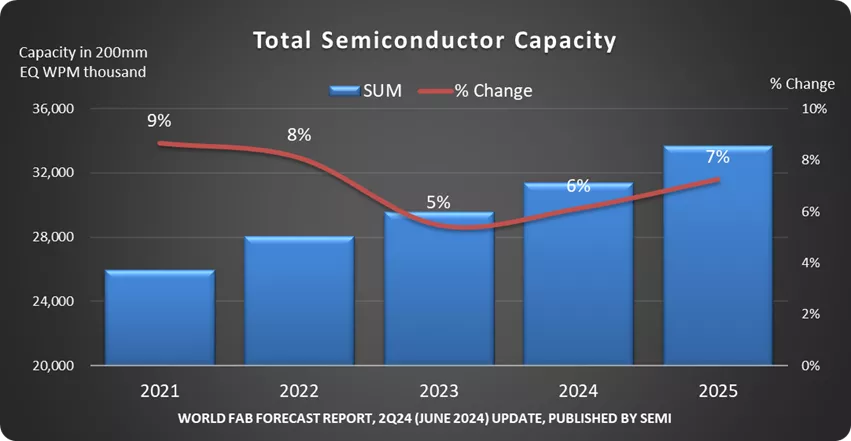
SEMI, the global industry association serving the electronics design and manufacturing supply chain, has released a forecast projecting a dramatic 69% increase in advanced chipmaking capacity through 2028, driven primarily by surging demand for artificial intelligence infrastructure. Advanced process capacity — defined as nodes at 7 nanometers and below — is expected to grow from approximately 850,000 wafers per month in 2024 to 1.4 million wafers per month by 2028, representing a compound annual growth rate of 14%. A key milestone in this trajectory is the anticipated breach of the one-million-wafers-per-month threshold in 2026, marking a historic inflection point for the global semiconductor industry.
Key Statistics and the AI Demand Driver
The forecast underscores the degree to which AI workloads have fundamentally altered the trajectory of semiconductor manufacturing investment. Hyperscale data centers, AI training clusters, and inference hardware all depend on the most advanced logic nodes, where transistor density and power efficiency improvements directly translate into competitive AI performance. Leading foundries including TSMC, Samsung Foundry, and Intel Foundry are accelerating capital expenditure on sub-7nm capacity in response to customer commitments from AI chip designers such as NVIDIA, AMD, Google, and Amazon. The 14% CAGR projected through 2028 is notably higher than historical semiconductor industry growth rates, reflecting a structural rather than cyclical demand shift. In 2026, when monthly wafer starts are expected to exceed one million units at advanced nodes, the industry will have doubled its advanced capacity compared to levels seen just a few years prior.
Industry and Supply Chain Implications
The scale of capacity expansion outlined in the SEMI forecast has significant implications across the entire semiconductor ecosystem. Equipment manufacturers face sustained demand for deposition, etch, lithography, and metrology tools capable of operating at leading-edge geometries, including EUV and high-NA EUV systems. Chipmakers must simultaneously manage yield ramp challenges inherent to new process nodes while meeting aggressive customer delivery schedules. For the broader supply chain, the forecast signals that investment planning must extend well beyond near-term quarters. Fab construction timelines of two to three years mean that capacity coming online in 2027 and 2028 requires investment decisions and materials commitments being made today. Countries and regions competing for semiconductor self-sufficiency — including the United States, European Union, Japan, and South Korea — are providing incentives that further accelerate these capacity buildouts, adding geopolitical complexity to supply chain planning.
Semiconductor Materials Perspective and Outlook
For companies operating in the semiconductor materials supply chain, the SEMI forecast represents both a significant growth opportunity and a call to action on supply security. Advanced node fabrication is substantially more materials-intensive per wafer than mature node production. Each successive process shrink introduces new materials requirements — from high-k dielectrics and metal gate stacks to novel etch chemistries, CMP slurries, and photoresist formulations compatible with EUV exposure. The 69% capacity increase through 2028 will drive commensurate demand growth across specialty gases, wet chemicals, chemical mechanical planarization consumables, and deposition precursors. Supply chain resilience has become a priority concern following disruptions experienced in recent years, and leading chipmakers are increasingly requiring dual-source qualification and regional supply redundancy from their materials partners.
For companies like Full Chain Materials, which specialize in sourcing and distributing advanced semiconductor materials including specialty gases, chemical precursors, and process chemicals, this forecast represents a period of substantial opportunity. Meeting the demands of a rapidly expanding advanced node capacity base requires not only product breadth but also the logistical capability, technical expertise, and supplier relationships to ensure timely and reliable delivery. As the industry crosses the one-million-wafer-per-month milestone in 2026 and continues its expansion toward 1.4 million wafers per month by 2028, materials supply chain partners positioned to scale with this growth will play an indispensable role in enabling the AI-driven semiconductor expansion.
