
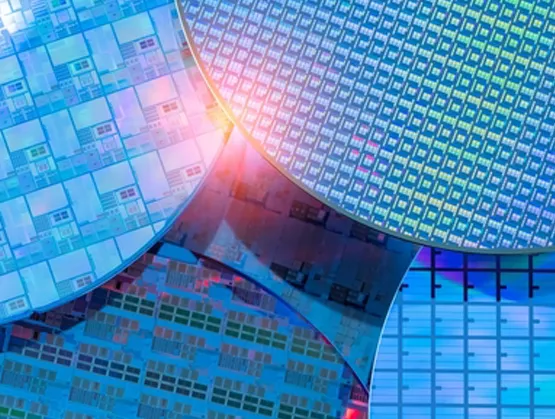
Worldwide silicon wafer shipments in 2025 increased approximately 6% year-over-year to reach 12,973 million square inches (MSI), while total industry revenue climbed to $11.4 billion. This marks a meaningful recovery from the prior year's downturn, as the semiconductor industry regained momentum driven by surging demand from artificial intelligence infrastructure buildout and a gradual normalization of inventory levels across the supply chain. The rebound confirms that silicon wafers — the essential substrate for virtually all semiconductor devices — remain a critical barometer of broader industry health.
AI Logic Chips Drive Demand for Advanced Epitaxial Wafers
The primary growth engine in 2025 was robust demand for advanced epitaxial wafers used in AI logic chips. As hyperscalers and cloud computing providers accelerated their investments in data center GPU clusters and custom AI accelerators, chipmakers significantly ramped production of leading-edge processors at advanced nodes. Epitaxial wafers — which offer superior crystal quality, tighter resistivity control, and reduced defect density compared to standard polished wafers — are preferred substrates for these high-performance devices. The demand spread across 300mm wafers, which now account for the vast majority of revenue, with the largest wafer size commanding premium pricing due to the complexity and precision required in their manufacture. Memory wafer demand also showed improvement as the DRAM market recovered from its cyclical trough, supported by high-bandwidth memory (HBM) requirements for AI training and inference workloads.
Industry Implications and Market Concentration
The 6% volume growth, combined with the revenue trajectory reaching $11.4 billion, signals meaningful pricing improvement as wafer suppliers regained some leverage following a prolonged period of oversupply and price concessions. The silicon wafer market remains highly concentrated, with the top five suppliers — Shin-Etsu Chemical, Sumco, Siltronic, SK Siltron, and GlobalWafers — collectively controlling the vast majority of global capacity. These manufacturers have been cautious about capacity expansion given the capital intensity of wafer production and the volatility of semiconductor cycles. As a result, the recovery in demand has translated more directly into pricing gains rather than volume-driven margin compression. Looking ahead, the transition to gate-all-around (GAA) transistor architectures at sub-3nm nodes is expected to further increase wafer quality requirements, potentially supporting premium pricing for advanced epitaxial substrates.
Supply Chain Impact and Outlook for Semiconductor Materials
The silicon wafer recovery has positive ripple effects throughout the semiconductor materials ecosystem. Upstream suppliers of polysilicon, quartz crucibles, dopant gases, and polishing compounds all benefit from increased wafer production volumes. The uptick also reflects improved utilization rates at wafer fabrication facilities globally, which in turn drives consumption of process chemicals, specialty gases, and other consumable materials used in chip manufacturing. Geopolitical considerations continue to shape investment patterns, with governments in the United States, Europe, Japan, and South Korea actively incentivizing domestic semiconductor manufacturing capacity — a trend that is likely to sustain above-trend wafer demand through the latter half of the decade as new fab capacity comes online.
For semiconductor materials suppliers such as Full Chain Materials, the 2025 silicon wafer market recovery underscores the durable, long-cycle growth dynamics that underpin the industry. As chipmakers push toward more advanced process nodes and expand their manufacturing footprints, the demand for high-purity specialty gases, chemical precursors, and advanced substrate materials will continue to grow. Full Chain Materials is well positioned to support customers across this expanding value chain, providing the science-based solutions and supply chain expertise necessary to keep pace with the accelerating demands of next-generation semiconductor manufacturing.
