
Silicon Carbide (SiC) semiconductors have undergone a remarkable transformation in 2025, moving well beyond their established role in electric vehicle powertrains to become indispensable components in AI data center power infrastructure. As artificial intelligence workloads impose unprecedented demands on power conversion efficiency, SiC devices have emerged as the material solution of choice for hyperscale operators and infrastructure builders seeking to manage energy costs and thermal constraints at scale. Industry leaders Wolfspeed and STMicroelectronics both announced the completion of their transitions to 200mm SiC wafer production lines, marking a pivotal shift that dramatically improves wafer yield and brings down unit costs.
Market Growth and Key Statistics
The global SiC power semiconductor market reached an estimated $4.2 billion in 2025, with analysts projecting a compound annual growth rate (CAGR) exceeding 20% through 2030. AI data centers now represent the fastest-growing demand segment, surpassing electric vehicles for the first time in 2025. Data center operators running GPU clusters for large language model training require power delivery units (PDUs) and voltage regulators capable of handling rapid load transients with minimal losses. SiC metal-oxide-semiconductor field-effect transistors (MOSFETs) and Schottky barrier diodes operating at switching frequencies above 100 kHz deliver power conversion efficiencies exceeding 99% in server rack power supplies, a level simply not achievable with conventional silicon-based devices. Meanwhile, electric vehicle demand for SiC remains robust, with on-board chargers and main inverters in premium platforms from leading automakers relying on 1200V SiC modules to enable faster charging cycles and extended driving range.
Industry Implications and Technology Transitions
The transition to 200mm SiC substrates is the single most consequential development in the SiC supply chain in 2025. Historically produced on 150mm wafers, SiC device manufacturers faced persistent challenges with substrate defect density — particularly micropipe defects and basal plane dislocations — that limited yield and drove up cost per die. The move to 200mm increases the number of dies per wafer by approximately 78%, providing substantial economies of scale. Wolfspeed's Mohawk Valley fab in New York, dedicated exclusively to 200mm SiC production, ramped to meaningful volume in 2025, while STMicroelectronics accelerated its own 200mm ramp at its Catania facility in partnership with Sanan Optoelectronics. Onsemi and Bosch similarly advanced their substrate and epitaxy capabilities, intensifying competition across the full SiC value chain. The net effect is a more competitive pricing environment that is accelerating SiC adoption into mid-range EV platforms and industrial power conversion applications that were previously cost-prohibitive.
Supply Chain Impact and Materials Perspective
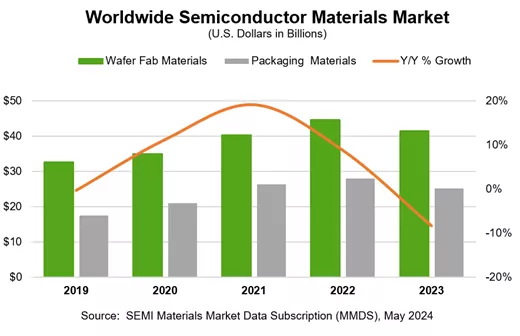
SiC device manufacturing is highly materials-intensive, and the expanded production volumes in 2025 are generating substantial new demand across several specialty material categories. High-purity silicon carbide powder used in sublimation crystal growth, the dominant method for producing SiC boules, must meet stringent specifications for metal impurity content — typically below 1 part per billion for critical elements such as boron, nitrogen, and aluminum. Specialty gases including silane, hydrogen chloride, and nitrogen trifluoride are consumed in chemical vapor deposition (CVD) epitaxy processes that build the active device layers on SiC substrates. Ion implantation requires high-purity nitrogen and aluminum precursors to form the p-type and n-type regions that define transistor behavior. Chemical mechanical planarization (CMP) slurries formulated specifically for SiC — a material orders of magnitude harder than silicon — represent another specialized materials category experiencing demand growth. Manufacturers are also investing in advanced packaging materials, including high-temperature silver sintering pastes that replace traditional solder and enable device junction temperatures above 200°C.
For semiconductor materials supply chain specialists such as Full Chain Materials, the SiC boom presents substantial opportunities to serve both established device manufacturers and emerging entrants. Ensuring reliable sourcing of high-purity SiC powder, specialty process gases, epitaxy precursors, and advanced packaging materials is critical as the industry scales. Full Chain Materials' expertise in connecting global specialty chemical and materials suppliers with semiconductor manufacturers in Asia positions the company well to support customers navigating the rapid capacity expansions and qualification cycles that characterize this dynamic segment of the semiconductor materials market.
